Why I Stepped Away From TDSE and Built My Own Training Method
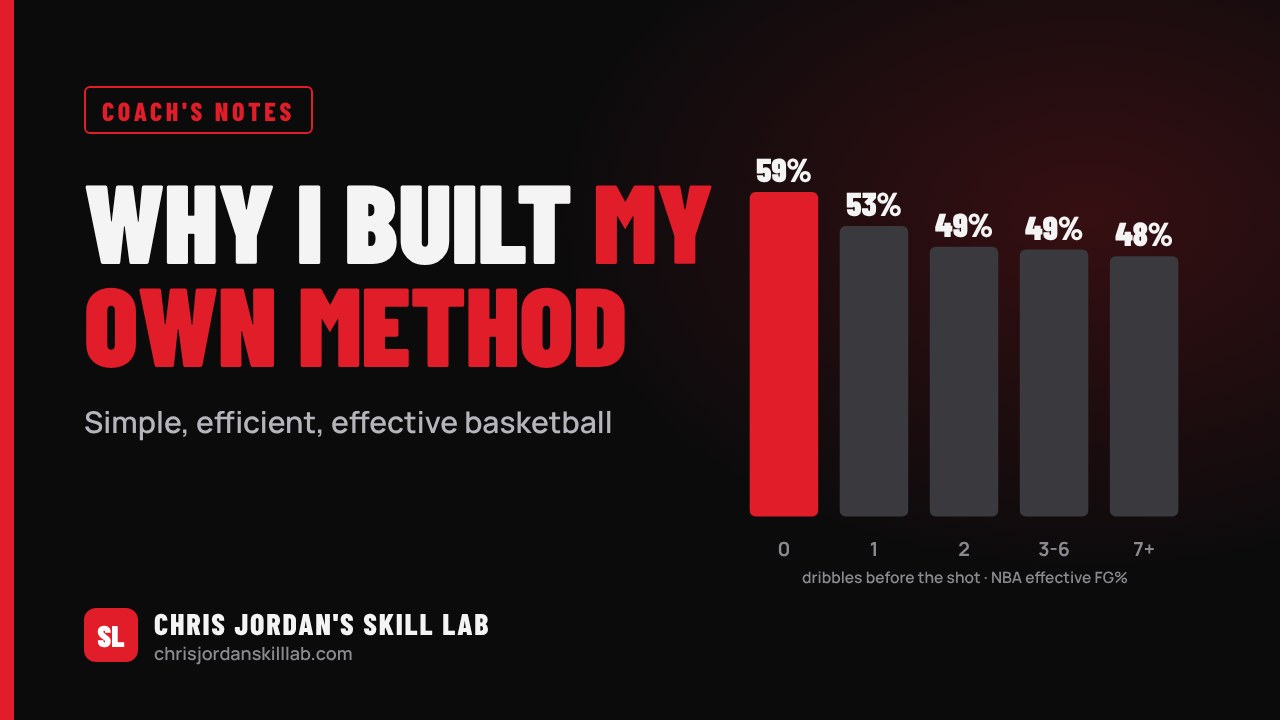
A couple of years ago I wanted to become a better trainer, so I signed up for TDSE certification with Micah Lancaster. It was one of the best decisions I ever made as a coach. I'm writing this to explain why I've stepped away from it anyway, and what I do now instead.
Where I started
TDSE made me exponentially better. I ran his curriculum on myself first, and it taught me to break down the details of footwork, ball handling and shooting in a way I never had before. It changed how I play the game and how I think about the game.
I went all in. I bought most of the equipment: the footwork mat, the lights, the cones, and the attachments and accessories that go with them. Plenty of the players I train got better from it too, and I'm grateful for all of it.
When it started to feel off
In the last year my thinking changed. Skill training, especially on social media, started to feel like it was about fancy moves and what looks good on camera, not what actually works in games.
Scroll through any trainer's page and you'll see the same thing. A long chain of ball handling moves into a shot or a layup. If the session is about ball handling, fine. But 95% of the time, nobody does 20 moves in a game. A player gets one or two moves, and the coach wants them at a spot on the floor: a layup in one or two dribbles, a drive downhill and a kick to the open player in the corner, or playing within the set.
It hit me harder when I sat down to plan workouts. I'd open the TDSE app to brainstorm and feel mentally bankrupt. I felt like I needed a specific footwork for every drill, then a specific tool to go with that footwork. Over time it got confusing and exhausting, to the point where I needed a break from training.
So after some time off, I started building my own workouts from scratch. In a lot of ways I went back to how I originally trained.
What the game actually rewards
The best shots in basketball come with the fewest dribbles. I pulled the NBA's own tracking numbers for the 2024-25 season to check it, and the drop is real.
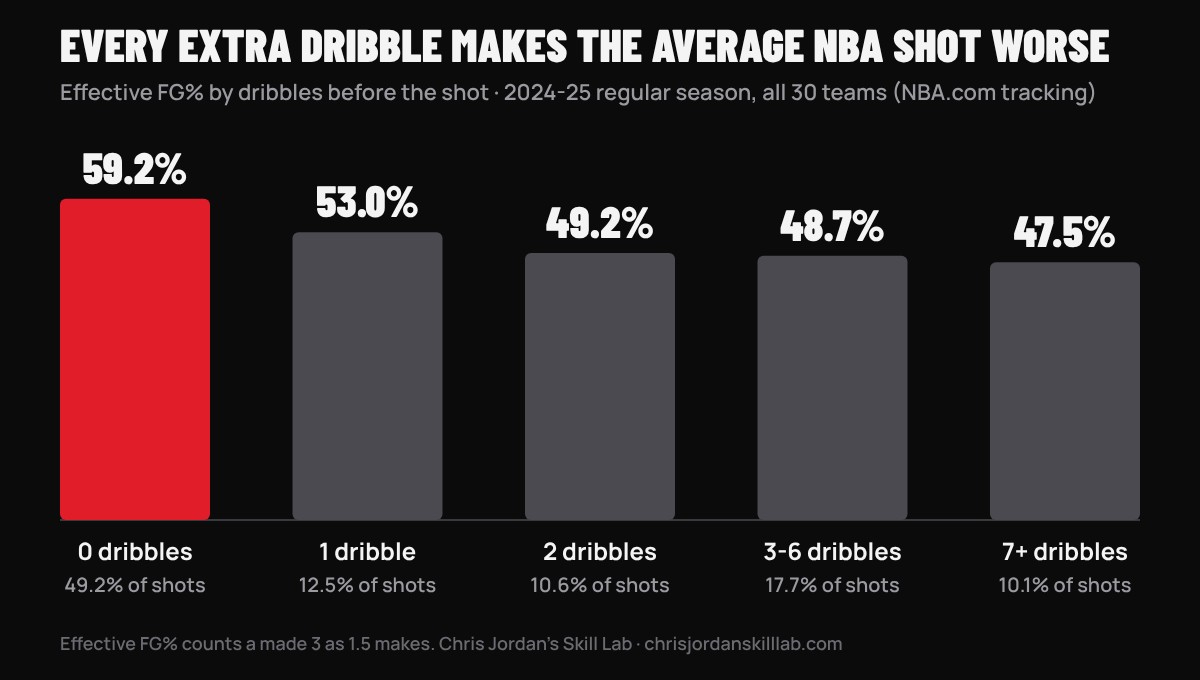
Almost half of all NBA shots came with zero dribbles, and those were the most efficient shots in the league. About 72% of all shots came after two dribbles or fewer. Shots after seven or more dribbles were the worst of the bunch. The long dribble sequences social media loves most produce the worst shots on the floor.
Put it in points. A shot with no dribble was worth about 1.18 points. One dribble dropped it to about 1.06, two dribbles to about 0.98, and three or more to about 0.97. Over a season, that gap is the difference between an efficient offense and a bad one.
There's one catch worth saying out loud. Zero-dribble shots are efficient because someone already created the advantage: a hard drive, a kick-out, a screen, a cut. So the lesson isn't that dribbling is bad. It's that every dribble should create a shot for you or a teammate fast, not decorate the possession. That's exactly what we train.
The best players in the league know this. Watch Kyrie Irving's layups over a season and you'll notice most of them are two or three hard dribbles downhill into a normal layup. The wild, highlight reel finishes are a small slice of his game, even though they're the clips everyone shares and tries to copy.
Shai Gilgeous-Alexander is the same. Watch him closely and a lot of his game is simple: he attacks hard right or left, then pulls up for the mid-range or gets to the rim. He adds a counter like a step back or a speed stop when the defense cuts him off and he needs to stop or create space. Even on his big scoring nights, most of his buckets come off a screen and a quick attack to his spot or the rim, not long isolation possessions.
And remember, Kyrie and Shai get to isolate because they're stars. Most of the players I train aren't the star of their team yet. A player who spends all their reps on iso moves often never gets to use them, because that isn't their role. Most training is built for the star player. I'd rather build players with fundamentals strong enough to do those moves, who also understand that simple, efficient and effective wins.
What my girls group taught me
The real turning point came in my girls group. That group runs 8 to 12 girls a session. For a whole month, every time I brought out the footwork mat, they moaned about it.
They knew it helped them. I'd shown them on film how much their footwork had improved. They still didn't like it, because it made the game more complicated than it needed to be. They felt like they had to worry about every detail of what their feet were doing, because they were waiting to hear if it was right or wrong.
They liked the lights. They liked cone drills that held them accountable. The only time they liked the mat was when it showed them the exact spot on the floor I wanted them to get to.
That's when it clicked for me. I love TDSE. It changed how I play and how I think about the game. But at some point, being super detail oriented starts to hurt a player. They overthink everything, when the answer is usually to play and keep it simple.
Simple isn't the same as basic
I want to be clear about something. Keeping it simple doesn't mean I stopped caring about details. Details still matter. Footwork still matters. But details are there to serve one thing: putting the ball in the rim.
The question I ask now is simple. Does this detail help my player score, create a better shot for a teammate, or get a stop? If it does, we keep it. If it only makes the rep look cleaner on camera, it goes.
Think about how a young player experiences a game. The defense is moving, the crowd is loud, the coach is yelling, and the shot clock is running. There's no time to think about which foot lands first on a specific step. The player who wins that moment is the one who already knows what to do: attack the gap, make the simple read, and finish.
So the goal isn't to remove skill. It's to make the right skills automatic, so players can stop thinking and just play.
Less gear, more basketball
There's one more honest piece. I've invested over $2,500 in training equipment over the years, and at some point the gear started to feel like the focus instead of the player. Today there are sessions where I don't use any of it, because for my players it mostly made training more complicated.
What I kept from TDSE
Stepping away doesn't mean throwing everything out. I kept the parts that actually help players win:
- An eye for detail. I can still spot exactly why a move didn't work, whether it's a foot placement, a late read, or a bad angle. I just bring it up when it matters, not on every rep.
- Accountability. Players love the lights and cone targets because they get instant feedback and can't fake the rep. Those stay.
- The mat as a diagnostic tool. When a player can't see where their feet need to be, the mat shows them the exact spot. Then we put it away and go back to playing.
- A shared language for reacting to the defense. When I correct a player after a rep, I still use some of that framework to explain what the defense gave them and what the right answer was.
The difference is that these are tools I reach for when a player needs them. They're no longer the center of every session.
How I train now
Now I build sessions around fundamentals, efficiency and keeping it simple. Players can still explore their own game. I'll still use the TDSE framework to point out what they could have done with their feet or how to react to the defense. But the fundamentals are what made them more effective.
The old way: separate skills
The TDSE way, I'd pick three or four skills and spend about 10 minutes on each in a 60 to 90 minute session. Players got better, because they were in the gym working. But the skills never connected to each other. One drill never built into the next.
When I tried focusing on one or two skills and progressing them, new questions came up. When are they going to use this in a game? Are we over-dribbling? Where's the context?
The new way: one foundation that keeps building
Now every drill grows out of the one before it. Here's what a block built on the hook pass looks like:
- Hook pass reps.
- Player A drives into the paint in two or three dribbles and hook passes to the corner.
- Same drive and pass. Player B in the corner dribbles up to the wing, and Player A replaces B in the corner for a mid-range or three.
- Same start, but now A calls for a screen from B and they run a pick and roll. A passes to B, relocates behind the three-point line, catches a pass from another player, rips through and gets to the rim in two dribbles.
Everything builds off the first foundation: the hook pass. Players keep moving the whole time, so they stay engaged and get in shape to play through multiple game situations while tired.
We run that block for 10 to 15 minutes. Then we move to the next foundation, like the overhead pass: Player A drives from the right wing to the baseline and makes an overhead pass to the left wing or corner, and we progress from there.
In the last 15 minutes, we pick one specific skill or technique and progress that.
See the difference? Most of the session goes to fundamentals players will use many times every game. Only a small slice goes to the one skill they might use once every four or five games.
The decision rule
The biggest change is how I teach players to make decisions. From triple threat, a player has four options: drive left, drive right, shoot, or pass. They get about a second, or two dribbles at most, to commit. That one rule kills over-dribbling faster than anything else I've tried.
Once they beat their defender, it's a race to the rim. After the drive there are only a few outcomes:
- Clear lane: finish. The intention is always a layup.
- Cut off: counter or change direction.
- Cut off hard: stop, use your body to create space, and pull up.
- Help defense comes: kick it out to the open teammate.
Advanced players can still use every move they have. The point isn't to limit them. It's to stop the decision freeze and the extra dribble moves players add just to look good.
Three questions every drill has to pass
Before a drill makes it into a session, it has to pass three questions:
- Will this show up in a real game? If a player won't use it in games, it doesn't get reps.
- Can I explain it in one sentence? If a 12-year-old can't understand the goal right away, it's too complicated.
- Does it need almost no setup? In a group of 8 to 12 players, time spent setting up equipment is time not spent playing.
And every rep ends with a make or a miss that counts. Makes are the scoreboard. Nothing else matters if the ball doesn't go in.
What's changed for my players
Since I made the switch, my players score more and play more effectively, because they're not worried about how their footwork looks. I see more confidence, not just in games but in one on one and four on four too.
They're more decisive. They know to attack full speed left or full speed right instead of going into a bag that's going to get them benched.
You can see it in their games:
- Evelyn Reaves once left a team where her game kept shrinking. At the Midlothian Heritage Tournament she scored a season-high 19 points on 47% shooting, made plays for her teammates, and her team brought home the gold.
- Olivia Reaves made huge defensive plays on that same gold-medal team.
- Myka Dalton has trained with me since before TDSE, so she's lived every version of my coaching. She was a decent 7th grader. As I shifted toward simple, efficient scoring built on footwork and fundamentals, she averaged 20 PPG in 8th grade, 24 PPG on JV as a freshman, and earned a varsity spot as a sophomore.
None of them got there with a highlight reel. They won with simple, decisive basketball.
What parents should look for in a trainer
If you're a parent choosing a trainer, here's what I'd watch for in any session, mine included:
- Do the drills look like basketball? Players should be reading, passing, cutting and finishing, not just dribbling in place.
- How many dribbles before a shot? Most reps should end in a shot or layup within one to three dribbles. (More on that in how to improve your shooting.)
- Are players moving most of the session? Long lines and long explanations mean fewer reps.
- Does the trainer count makes? Progress you can measure beats a session that just felt hard.
- Is it built for your kid's role? Not every player needs to be trained like the star. Every player needs fundamentals that get them on the floor.
- Does your athlete play more confidently in games? That's the only scoreboard that matters.
Still deciding on a format? Here's my honest breakdown of small group vs private training, and my parent guide to basketball training in Wylie, TX.
The bottom line
TDSE gave me the eye for detail. Simple, efficient and effective is what gets the ball in the rim. That's what we train at Skill Lab now, in small groups of 8 players or fewer at 1400 Martinez Lane in Wylie, TX, for families across Wylie, Murphy, Sachse and Plano.
Want to see it for yourself? Book a $40 evaluation and I'll show you exactly where your athlete stands and how we'll build their game. Not sure where your athlete stands yet? Take the free 60-second player scorecard.
Sources
- NBA.com Teams Shooting Dashboard: Dribbles, 2024-25 regular season. Figures combine all 30 teams, one dribble range at a time.
- The Kyrie Irving and Shai Gilgeous-Alexander points are my own observations from watching their games.
By Chris Jordan, founder of Chris Jordan's Skill Lab in Wylie, TX.